
Sperm Morphology
The Structure of Human Sperm
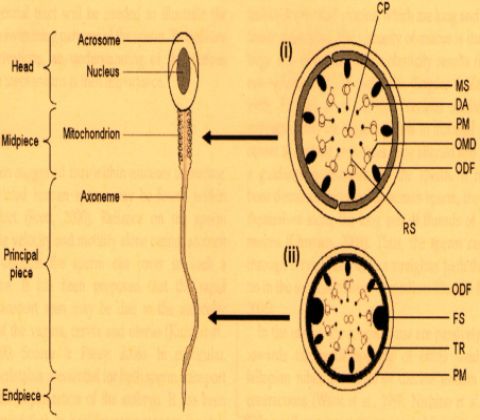
Understanding the physiology of the human sperm is essential to understanding sperm function in fertilization. Like most normal mammalian sperm, human sperm comprises a head and tail or the flagellum. The flagellum consists of a mid-piece and a principle piece. The image shows a typical sperm and selected ultrastructure of its flagellum.
Head Piece
The headpiece plays an important role in the sperm attachment to the oocyte zona pellucida (ZP). This is a crucial step in initiating fertilization. The head piece also contains various enzymes that enable sperm penetration into oocyte zona pellucida upon oocyte attachment.
The Flagellum
Sperm motility is dependant on their flagellum. Mammalian flagellum internal structure is comlex.
The midpiece is composed of nine outer dense fibers (ODF) surrounding each of the nine outer axoneme microtubule doublets (OMD) and by a sheath of mitochondria that encloses the ODF and the axoneme. The midpiece has a high concentration of mitochondria. The mitochondria provide energy for sperm movement in the form of ATP.
The axoneme
The axoneme is composed of microtubules in a typical axoneme arrangement of ‘9 + 2’. The central pair of singlet microtubules (CP) are surrounded by nine OMD and enclosed by a plasma membrane. The outer nine microtubules posses’ radial spokes (RS) that enable interaction with the central pair of microtubules. The axoneme is powered by dynein molecular motors. Sliding between pairs of outer doublets powered by dynein causes the bending of the axoneme. The bending of the axoneme provides sperm motility.